

David Hyde Pierce’s Quiet Coup on Set: What Happens When the Quiet One Speaks Up?
David Hyde Pierce took a stand on the Wet Hot American Summer set, advising Paul Rudd and Amy Poehler to dial it back. But what does this subtle power move reveal about the art of control, the dynamics of celebrity, and the quiet voices that shape the loudest moments?
 Chris MarksMay 6, 20252 Mins read92
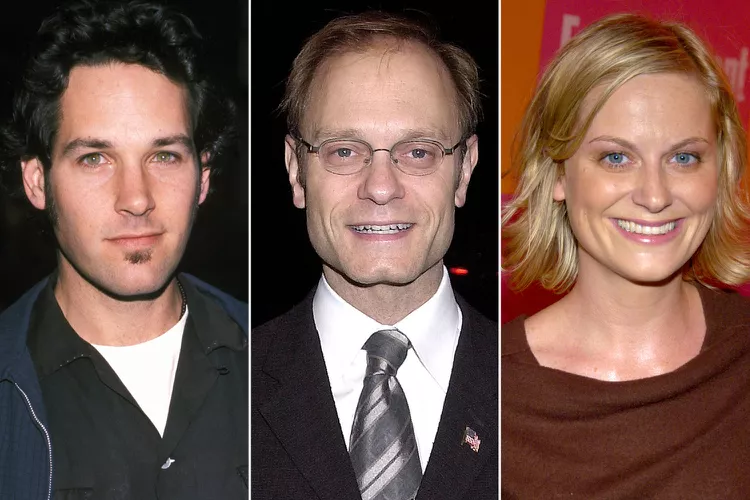
On the chaotic set of Wet Hot American Summer, where rapid-fire jokes and improv reign supreme, David Hyde Pierce quietly issued a command: “Be a little quieter.” To outsiders, his words might seem unremarkable. To those in the know, they speak volumes about the undercurrents of power and the delicate art of maintaining control when surrounded by comedic titans. What does it take to reign in the likes of Paul Rudd and Amy Poehler, two of comedy’s most energetic forces? And why did Pierce, who often plays the reserved, cerebral type, feel the need to intervene?
It is in moments like these—unseen, behind-the-scenes exchanges—that the real nature of celebrity dynamics is revealed. While Rudd and Poehler’s performances on screen may exude an effortless charm, the real story is about the control and direction that takes place off-screen, in the quiet of the green room, or in this case, on set. When Pierce asked for restraint, he wasn’t just curbing volume—he was shifting the balance of power, asserting that sometimes silence is the loudest voice in the room.
The Silent Strength of David Hyde Pierce
Pierce’s reputation for playing characters who are at once reserved and full of subtext is no accident. On screen, he is often the understated one—the voice of reason in a world of chaos. But what if that same quiet confidence is the very thing that gives him the authority to shape moments, even when surrounded by bigger personalities? “There’s power in silence,” Pierce once remarked in an interview, a sentiment that perfectly encapsulates his on-set maneuvering.
In a world where everyone clamors for attention, where the loudest voices seem to control the narrative, the quiet ones often wield the most subtle power. Pierce’s quiet intervention is a study in control—an unspoken assertion that, even in a sea of comedic chaos, there’s room for measured restraint.
Reverberations Through the Noise
The true weight of Pierce’s words wasn’t just in what they did to Rudd and Poehler, but in what they symbolized: a shift in how we view power in entertainment. It’s easy to imagine a set where egos clash, where louder voices dominate. But Pierce, with his cool demeanor, didn’t need to shout to be heard. In the delicate, almost invisible art of directing the flow of an ensemble, he chose precision over volume. This is what makes his quiet coup so profound: it was about shaping the rhythm of the set without drawing attention to himself.
The moment speaks to a larger theme in the world of Hollywood: control is not always about being the biggest personality in the room. It’s about knowing when to speak, and when to let the silence settle like a weight. Pierce’s subtlety offers a lesson not just for aspiring actors or directors, but for anyone seeking influence in a world that often mistakes noise for power.
In the end, David Hyde Pierce’s quiet request on the set of Wet Hot American Summer wasn’t just about lowering the decibels—it was a reminder that even in the loudest places, the most measured voices often carry the most weight. And perhaps that is the true art of control: knowing when to speak, and when to let the silence do the talking.






Start the New Year by Investing in Yourself – Hollywood Life
Image Credit: European Wax Center The new year is all about fresh...
 Kirsten Collins2 Mins read

Where Is Liam Conejo Ramos Now? Updates on 5-Year-Old’s ICE Detainment – Hollywood Life
Image Credit: Getty Images Liam Conejo Ramos came home from preschool while...
Kirsten Collins2 Mins read

AirTalk Wireless Offers Free Wireless Service to Underserved Folks, Online & Offline – Hollywood Life
Image Credit: Pexels California may be home to Silicon Valley, but many...
Kirsten Collins3 Mins read
Who Is Harry Styles’ ‘Aperture’ About? Breakdown of the Lyrics – Hollywood Life
View gallery Image Credit: Getty Images We’ve doing doing all this late...
Kirsten Collins1 Mins read




Leave a comment