

The Maple Leafs vs. Panthers: Is the Game Really About the Bets, or the Unseen Forces of Fate?
Game 2 of the NHL Playoffs promises to be a spectacle, but beyond the player prop bets and shifting odds, there's a deeper question: Are we betting on the players, or are we betting on fate itself?
 Chris MarksMay 4, 20253 Mins read128
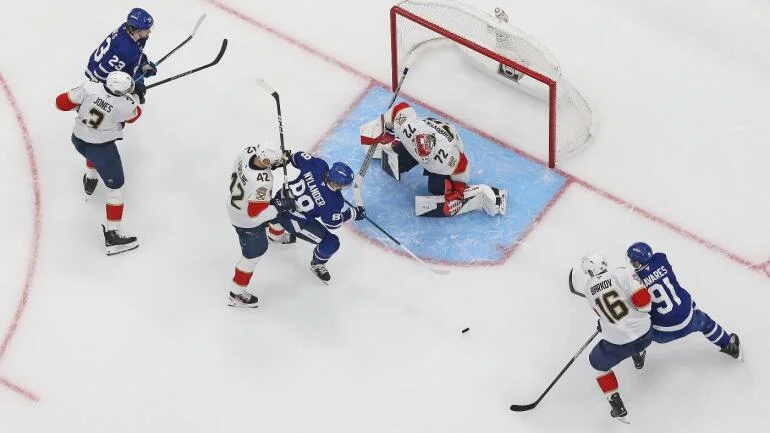
There is an unsettling truth that the statistics don’t quite capture: the real magic of the NHL Playoffs is not in the players’ feet or sticks, but in the minds of the bettors. When the Maple Leafs face off against the Panthers in Game 2, we find ourselves not just analyzing goals and assists, but also scrutinizing numbers that twist and bend like shadows in the dark. Behind each prop bet lies the question—are we watching a game of hockey, or are we simply watching the spectacle of prediction, fortune, and fate?
In the world of player prop bets, the game seems to take on a life of its own. Take Auston Matthews, for instance. He’s the golden boy of Toronto, a player whose name is woven into the fabric of Leafs’ playoff hopes. But will he score in Game 2? The betting world seems certain, offering odds that suggest a foregone conclusion. Yet, if you’ve been paying attention to the ebb and flow of the playoffs, you’ll know that certainty is the first casualty when the stakes are this high. Is Matthews really destined to find the back of the net, or is there some hidden chaos at play—some unpredictable element that could tip the scales in the Panthers’ favor?
The Game Within the Game
What’s truly fascinating about the game of prop betting is how it plays into the narratives we’ve created around these teams. Take William Nylander, who’s been quietly building a case for himself as one of the most dangerous players on the ice. For all the attention Matthews garners, it’s Nylander who often slips under the radar, both on the ice and in the betting markets. And yet, as the Leafs face the Panthers, his ability to change the game in subtle, unseen ways may be the one factor that actually shifts the balance. A sudden assist, a clutch goal, a moment of magic that doesn’t show up in the stats but is felt deeply by the players and fans alike.
Is this the real story of Game 2? Are we so obsessed with the numbers—Matthews’ goals, Tkachuk’s assists—that we’re missing the fleeting moments that ultimately decide the game? After all, hockey isn’t just a game of pucks and sticks; it’s a game of invisible forces, of players reading the ice in ways that defy logic, and of the strange, magnetic pull of momentum. As analyst Scott Morrison put it, “It’s not always about the stats; sometimes, it’s about the flow—the hidden currents underneath the surface.”
The Curse of the Bet
If we’re honest with ourselves, there’s a deep tension here: the more we bet on the game, the less we seem to enjoy the spontaneity that defines it. By betting on players to score or collect points, we reduce the game to a set of probabilities, as if we could distill all the passion, chaos, and history of the NHL into a neat little wager. But in doing so, do we lose something essential?
Think about the unpredictability of hockey: a game of inches, a game of decisions made in split seconds. The odds, for all their precision, can never account for that. The Leafs may be favored in the betting markets, but in the final analysis, we are all just gamblers—dancing with the same uncertainty, hoping to extract something concrete from the void.
The question, then, is whether the thrill of the bet is enough to sustain us. Will the predictions hold up, or will fate step in and rewrite the script entirely?
In Game 2, as Toronto faces off against Florida, the story is no longer about Matthews or Tkachuk, Nylander or Barkov. It’s about the game itself—and whether we’re willing to accept that the outcome, no matter how much we bet on it, is never really ours to control. So, as you watch the game tonight, ask yourself: Is it about the scoreline, or is it about the mystery of what might happen when the final whistle blows?






Barcelona’s Fragile Pursuit: When Injuries Threaten More Than Just a Season
A silence spreads over Camp Nou that no roar can drown out—two...
Chris Marks2 Mins read

William Saliba: Arsenal’s Silent Architect or Its Greatest Gamble?
The air inside the Emirates shifts with unspoken tension—William Saliba, once a...
 Joseph Bennett2 Mins read

Joel Embiid’s Quiet Confidence: Is the 76ers’ Giant Ready to Rewrite His Story?
Joel Embiid is rarely one to make noise without purpose, and now,...
 Kirsten Collins1 Mins read
Juventus, Atalanta, and Arsenal’s Quiet Revolution: What’s Really Shaping This Week in Football?
The roar of Serie A stadiums masks a subtle shift, one that...
Kirsten Collins2 Mins read





Leave a comment