

The Bruise Beneath the Helmet: What Mike Vrabel Knows That Rookie Patriots Don’t
Mike Vrabel isn't warning Patriots players to keep the peace—he’s reminding them where football really hurts. Not in the scuffle, but in the memory.
 Kirsten CollinsJuly 28, 20252 Mins read28
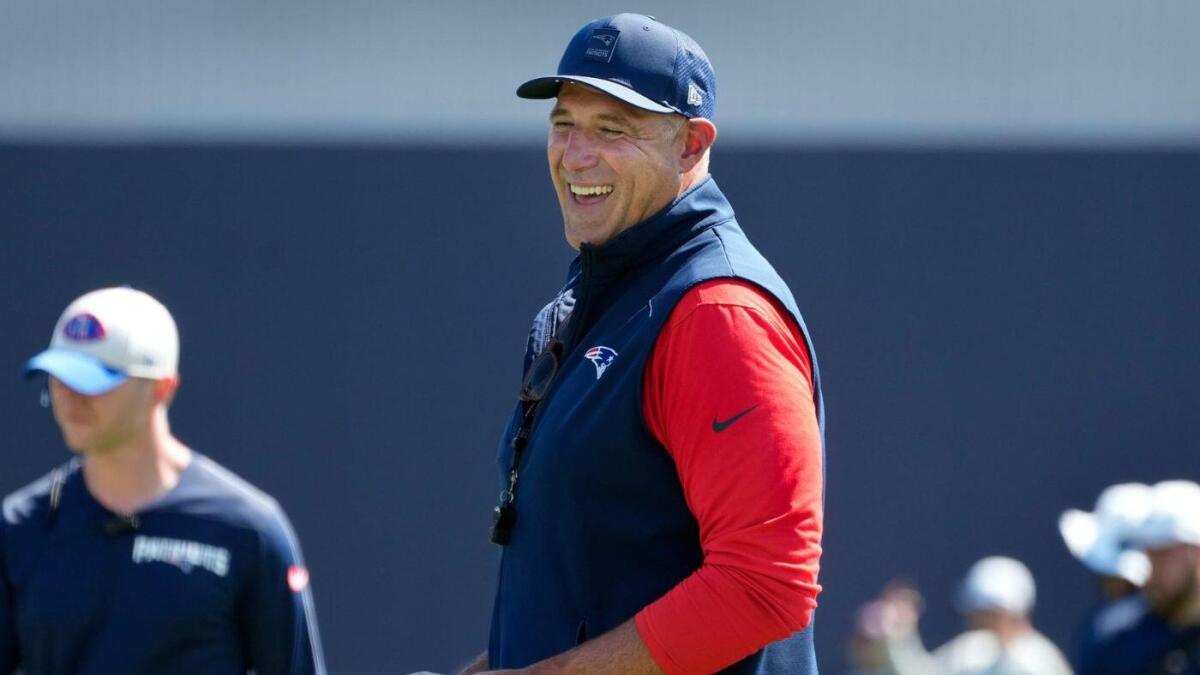
It starts with a helmet glance—slightly too long, a few degrees too aggressive. The kind of look that says you’re not supposed to be here, and the kind that rookie players have been answering with their fists since the NFL was still wearing leather. But Mike Vrabel isn’t impressed. Not anymore.
In a closed-door moment, the former linebacker-turned-coach delivered a warning that wasn’t about discipline—it was about memory. “Don’t do it,” he said, referencing the infamous training camp fight he got into as a rookie with the Steelers. His voice didn’t rise. It didn’t need to. The weight of regret hung heavier than any helmet.
Because Vrabel knows what young players haven’t yet learned: that the first real injury in football isn’t to the body—it’s to the myth you built around yourself. The myth that toughness equals violence. That control is weakness. That war begins at camp.
Where the Bruises Really Begin
Football’s brutality is no secret. But its quiet violence—emotional, hierarchical, psychological—is often shrouded by highlight reels and heroic narratives. Training camp, for all its choreography, is a pressure cooker of unspoken rules and invisible rankings. And when a fight breaks out, it doesn’t showcase strength—it exposes fear.
Vrabel wasn’t just recalling a scrap. He was naming a moment of misjudgment that lives, years later, like a soft echo in the back of his mind. In his telling, that fight didn’t define him—it diminished him. “You think you’re earning respect, but really, you’re telling the vets you’re not ready,” he said, almost like a confession whispered to a younger version of himself.
And that’s what makes his warning to the Patriots so striking. It’s not about avoiding headlines. It’s about avoiding the long-haul shame of realizing you fought for the wrong reasons. That you were loud when the game called for stillness. That you confused impact with impulsivity.
The Quietest Player in the Room Is Usually the One to Watch
What Vrabel knows—and what he’s quietly passing on—is that real violence in football doesn’t announce itself. It happens in cut blocks, blindside blitzes, locker room decisions. The best players don’t swing—they wait. The smartest ones don’t yell—they study. And the most dangerous man on the field is rarely the one looking for a fight.
There’s a paradox in Vrabel’s presence: the battle-worn gladiator telling the next generation don’t swing. But maybe that’s the evolution of a man who’s lived too long inside the myth to still believe it. He’s not warning his players out of softness. He’s warning them out of experience.
Because the fight isn’t the test. The silence afterward is.
And somewhere, between the echoes of old tape and the sound of pads cracking in Foxborough heat, a rookie clenches his fists just slightly less tightly. Perhaps not because he’s calm—but because, for the first time, he knows the bruise he’s trying to avoid isn’t the one on his cheek.
It’s the one he might carry in memory, long after his jersey’s gone quiet.






Barcelona’s Fragile Pursuit: When Injuries Threaten More Than Just a Season
A silence spreads over Camp Nou that no roar can drown out—two...
 Chris Marks2 Mins read
William Saliba: Arsenal’s Silent Architect or Its Greatest Gamble?
The air inside the Emirates shifts with unspoken tension—William Saliba, once a...
 Joseph Bennett2 Mins read
Joel Embiid’s Quiet Confidence: Is the 76ers’ Giant Ready to Rewrite His Story?
Joel Embiid is rarely one to make noise without purpose, and now,...
Kirsten Collins1 Mins read
Juventus, Atalanta, and Arsenal’s Quiet Revolution: What’s Really Shaping This Week in Football?
The roar of Serie A stadiums masks a subtle shift, one that...
Kirsten Collins2 Mins read





Leave a comment