

The Cicadas Are Singing, but Who’s Pulling the Strings?
A fungal puppeteer has hijacked America’s noisiest insect, turning it into a bio-loudspeaker—and perhaps a glimpse into a future where nature plays synthetic notes.
 Kirsten CollinsMay 1, 20252 Mins read27
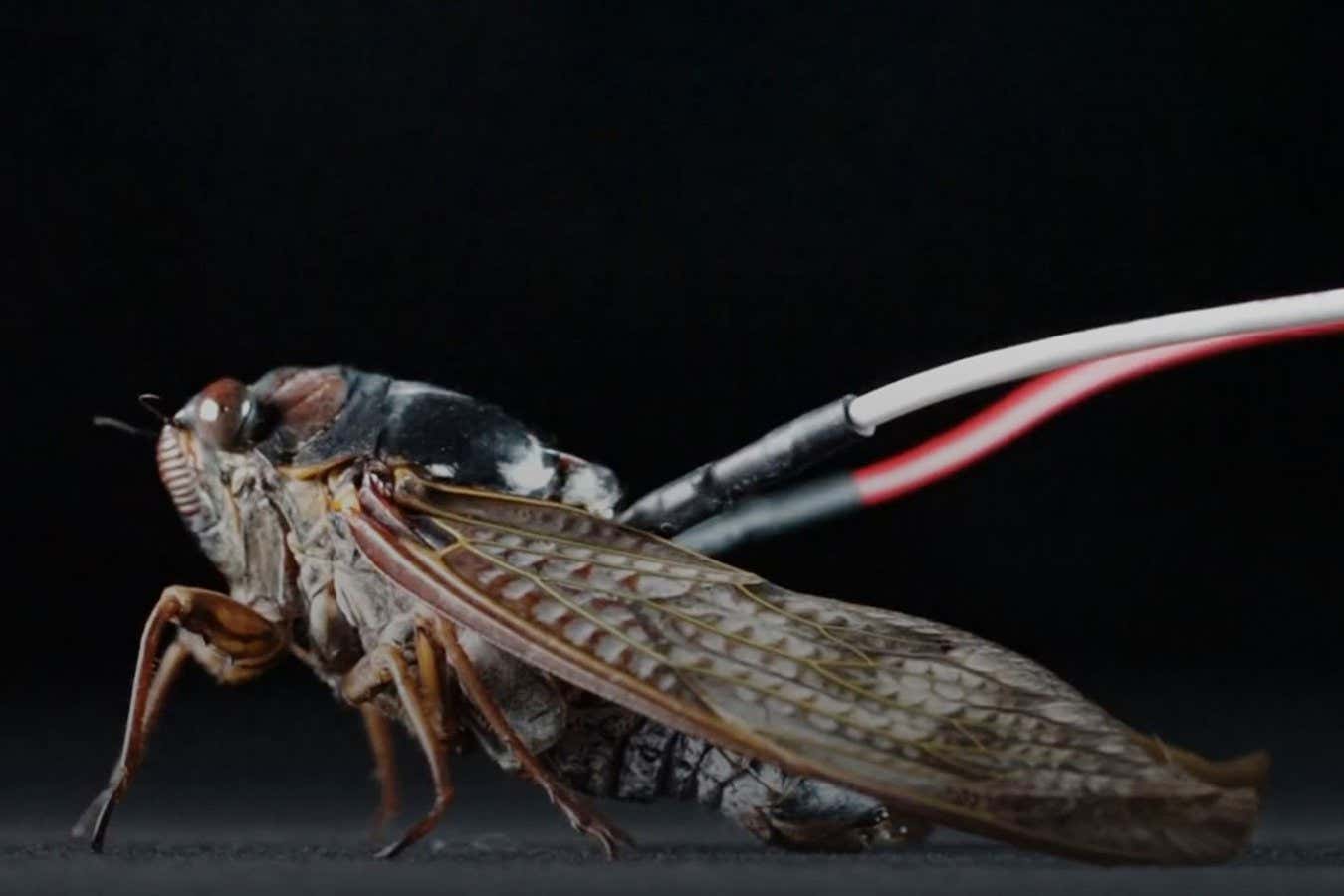
A cicada clicks like a malfunctioning speaker, its rhythm erratic, metallic—almost synthetic. But this is no glitch in an audio file. It’s an insect, its abdomen hollowed out and replaced by a mass of fungal spores, singing a tune it no longer controls. We’ve entered the age of biological possession, where a parasitic fungus doesn’t just kill—it choreographs.
The culprit is Massospora, a psychedelic, grotesquely intelligent fungus that infects male cicadas and overrides their bodies. The result? An insect that continues to fly, sing, and even attempt to mate—all while its lower half has rotted away. It’s been described as a natural bio-speaker, transmitting a song whose source has been divorced from agency. A puppet concerto with no strings, only spores.
Nature’s Remix of Free Will
It would be easy to dismiss this as a freak show of entomology—an oddity tucked away in the Appalachian woods. But the horror here is not just anatomical; it’s philosophical. What does it mean when agency is eroded so quietly, so completely, that the subject doesn’t even know it’s been taken?
Some scientists marvel at the efficiency. “It’s a masterpiece of evolutionary engineering,” one mycologist remarked, almost reverently, as if describing haute couture rather than death by design. The fungus doesn’t silence its host—it hijacks its microphone, its instincts, its performance. The male cicadas begin mimicking female wing-flicks, luring in other males, unknowingly spreading the infection in a cycle of miscommunication and loss of control.
And we—voyeurs of this unnatural symphony—begin to wonder: how different are we, really? If a fungus can rewrite behavior with the flick of a molecular switch, what happens when our own interfaces—our phones, feeds, and filters—start humming the same eerie tune?
The Sound of the Synthetic Wild
Cicadas have always been loud. Their chorus is an ancient pulse, older than cities, older than the written word. But now, with their songs being remixed by something that isn’t entirely alive or dead, the noise feels less like nature and more like a broadcast. It’s as if the forest itself is being tuned by an unseen hand, and every shriek is another signal sent out into the void.
In some twisted way, Massospora isn’t just infecting cicadas—it’s performing them. The body becomes an instrument. The behavior, a script. The wings, amplifiers for a soundtrack that doesn’t belong. We’re watching nature compose a new genre: parasitic performance art. A dark ambient track, scored in spore and decay.
This isn’t science fiction. It’s bio-reality. It’s happening now, at our feet, in our trees, under our skin of assumed autonomy.
So the next time you hear the droning hum of a cicada, ask yourself: who’s really making the music?
And are we already part of the chorus?







Microsoft Is Cutting Thousands of Employees Across the Company
Microsoft Corp. said it will cut thousands of workers with a focus...
Kirsten Collins1 Mins read

Intel Certifies Shell Lubricant for Cooling AI Data Centers
Intel Corp. has certified Shell Plc’s lubricant-based method for cooling servers more...
Kirsten Collins1 Mins read

UBS’s Lo Says Investors Diversifying From US to Gold, Crypto
UBS Group AG’s rich clients are increasingly shifting away from US-dollar assets,...
Kirsten Collins1 Mins read

Microsoft Among Software Stocks Offering Haven in Tariff Chaos
As the Trump administration’s trade war clouds the economic outlook, software stocks...
Kirsten Collins1 Mins read





Leave a comment