

Virtual Reality: The New Frontier in Military Ethics Training
In an era where warfare's moral complexities deepen, the Canadian military turns to virtual reality to prepare soldiers for ethical dilemmas on the battlefield.
 Kirsten CollinsJanuary 23, 20251 Mins read44
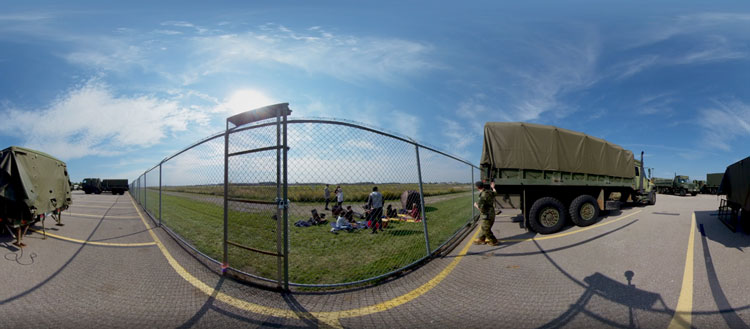
The battlefield has always been a crucible for moral judgment, where split-second decisions bear profound consequences. Recognizing the gravity of such moments, Defence Research and Development Canada (DRDC), in collaboration with the National Research Council of Canada, is pioneering the use of virtual reality (VR) to fortify soldiers’ ethical decision-making skills.
Traditional training methods often fall short in replicating the visceral intensity of real-life combat scenarios. Enter VR: a technology that immerses soldiers in lifelike situations, compelling them to navigate complex moral landscapes without real-world repercussions. This initiative aims to bridge the chasm between theoretical ethics and the harrowing realities faced during deployments.
Simulated Dilemmas, Real Emotions
Within these virtual arenas, soldiers confront scenarios meticulously designed to challenge their moral compass. Researchers monitor physiological markers, such as heart rate variability, alongside psychological responses like feelings of guilt or shame. This dual approach not only evaluates the effectiveness of VR training but also ensures that the simulations resonate on a deeply human level.
Dr. Megan Thompson, a leading defence scientist at DRDC, articulates the vision: “Ultimately, we hope that our research will be an important support to CAF personnel, providing our troops with a safe space to navigate how they might react in these difficult situations in an upcoming deployment.”
Adaptive Training for Individual Resilience
Beyond static scenarios, the research delves into intelligent adaptive VR systems capable of tailoring experiences in real-time to the individual trainee. Such personalization aspires to enhance readiness and potentially mitigate long-term psychological impacts, including moral injury—a condition stemming from actions that transgress one’s ethical beliefs. ISED Canada
As warfare evolves, so too must the methodologies that prepare those who serve. By harnessing VR, the Canadian Armed Forces signal a commitment not only to technological innovation but to the moral fortitude of their personnel. Yet, as virtual and reality converge in the training grounds, one must ponder: can simulated experiences ever truly encapsulate the weight of real-world decisions?







The Man Who Bled for Millions
He saved over 2.5 million babies, but no one ever recognized him...
Kirsten Collins2 Mins read
The Silence Before the Sneeze
A dead bird, limp on the edge of a sidewalk in Guangdong,...
Kirsten Collins2 Mins read

The Fetishization of Fear: RFK Jr. and the Vaccine Fetuses Lie
It begins, as these things always do, with a whisper dressed as...
Kirsten Collins2 Mins read
The Lie That Keeps Mutating
The seduction of scandal is ancient, but its latest host is disturbingly...
Kirsten Collins2 Mins read





Leave a comment