

Roki Sasaki’s Reinvention: Can the Rookie Close Strong in September?
Roki Sasaki’s debut season has been a study in promise unsettled—shoulder injury, control struggles, lowered expectations. But with his repertoire tweaked and the postseason looming, might this be where he turns the corner?
 Krista FreelandSeptember 18, 20252 Mins read68
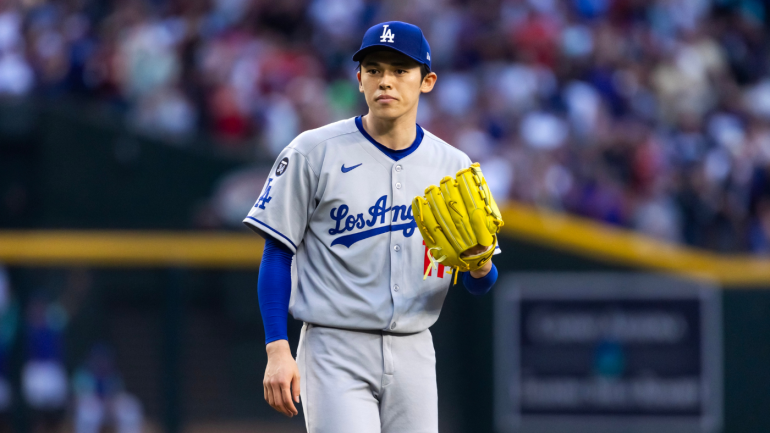
In a rehab outing, Sasaki’s fastball thundered near 99 mph, and for a moment, memories of his Japanese dominance flickered. But lightning in baseball is mercurial: velocity means little without control, repertoire without deception. Roki Sasaki, once a heralded newcomer, now fights not just to start—but to matter.
The Dodgers don’t have clarity yet: starter, reliever, bulk innings, or spot duty. What they have is a roster that could, if they choose well, include Sasaki in a meaningful playoff role. But the line between inclusion and expectation is thin.
His early numbers in the majors “haven’t lived up to the lofty expectations” placed on him, with a 4.72 ERA, 1.09 K/BB ratio, and fewer than five innings per start before injury. Since returning, his ERA has ballooned, his slider abandoned in favor of a cutter—used sparingly in the minors but showing promise. Chase% and Whiff% for that cutter are superior, though sample sizes remain small. The slider was once his go‑away pitch; now it’s the specter he’s trying to replace.
Sasaki has also trialed a sinker, seeking to counter what scouts called a “dead‑zone fastball”—movement that’s predictable unless speed or pitch‑mix evolve. If he can command the sinker or the cutter, perhaps he can regain the edge.
From Starter to Role Player?
Manager Dave Roberts has hinted Sasaki might be used differently down the stretch and in October. “We see him as that starter,” Roberts said—but also floated the possibility of bullpen work. A switch that would be uncharacteristic for Sasaki, who has pitched as a frontline starter in Japan and arrived in L.A. with that expectation.
Getting into the playoff roster may require humility and adaptation—delivering in brief stints, in high leverage moments, or as the swing arm when others falter. Sasaki said he’s “completely pain free” now and eager to test live hitters, to see whether the tweaks stick.
Adjustment Without Losing Identity
What is Sasaki if not fastball and splitter? If he removes his sweeping slider, adds a cutter, experiments with a sinker, what remains of the terrifying promise? The question is whether these changes dilute his strength or refine it. Identity in pitching is not style alone—but how the repertoire complements the arm, how fear is produced as much by movement and unpredictability as by velocity.
Fans remember Sasaki’s perfect game in Japan, his fastballs at 100+, his promise. But baseball is unforgiving: a curve to moderation, a dip in velocity, a shoulder that aches—each chips away. What remains will be revealed in October.
Roki Sasaki’s story isn’t a failure—it’s a work in progress, tiptoeing the edge between potential and pressure. He’s not guaranteed to make the playoff roster, but his tweaks give him a shot. Will they be enough?
When the playoffs begin, will we remember his velocity—or the courage it took to change?






Barcelona’s Fragile Pursuit: When Injuries Threaten More Than Just a Season
A silence spreads over Camp Nou that no roar can drown out—two...
 Chris Marks2 Mins read
William Saliba: Arsenal’s Silent Architect or Its Greatest Gamble?
The air inside the Emirates shifts with unspoken tension—William Saliba, once a...
 Joseph Bennett2 Mins read

Joel Embiid’s Quiet Confidence: Is the 76ers’ Giant Ready to Rewrite His Story?
Joel Embiid is rarely one to make noise without purpose, and now,...
 Kirsten Collins1 Mins read

Juventus, Atalanta, and Arsenal’s Quiet Revolution: What’s Really Shaping This Week in Football?
The roar of Serie A stadiums masks a subtle shift, one that...
Kirsten Collins2 Mins read





Leave a comment