

The Achilles Myth: Jayson Tatum, the Celtics, and the Price of Playing God
He walked into Patriots training camp without a boot—but what does Jayson Tatum’s Achilles miracle really signal? A comeback, or the beginning of something we’re not ready to name?
 Krista FreelandAugust 6, 20252 Mins read44
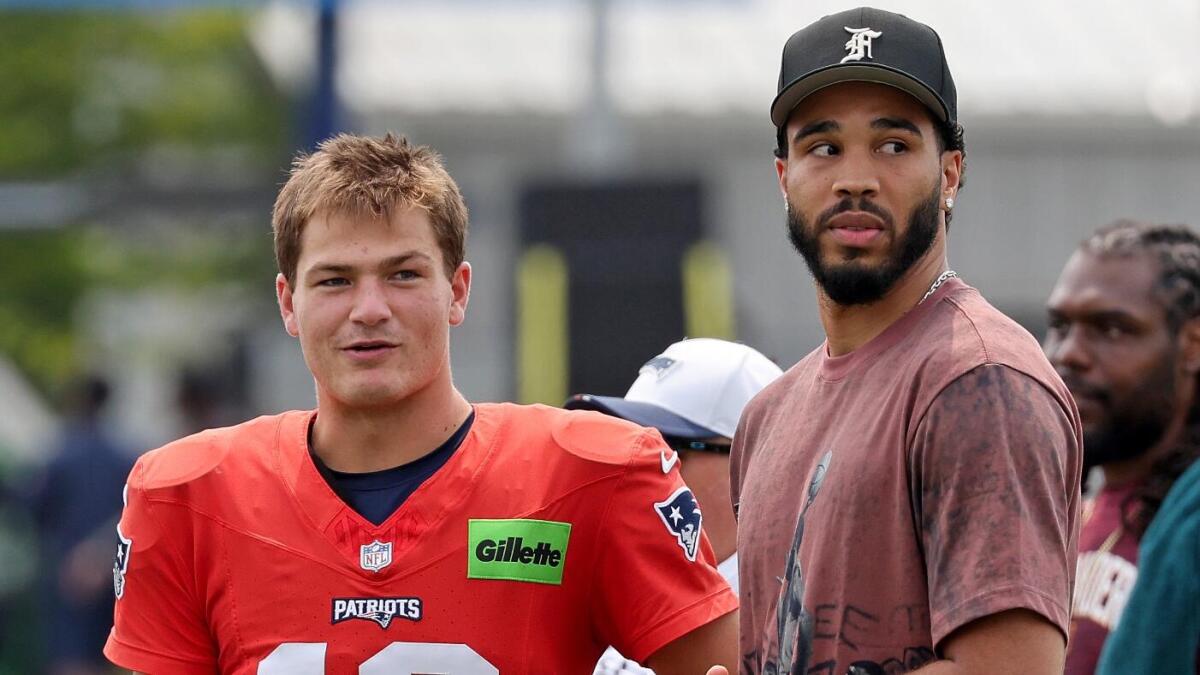
The walk was deliberate, almost cinematic. No boot, no brace, no limp—just Jayson Tatum, all six-foot-eight of him, strolling through Patriots training camp like he was reintroducing himself to the myth machine. Not as a man in recovery, but as something more mythical. A phoenix in Nikes. A cautionary tale, rewritten.
Only weeks ago, headlines whispered “Achilles tear”—that dreaded phrase which in basketball means either a year in limbo or the end of flight altogether. But here he was, unbothered and unburdened, as if the injury never happened or never mattered. The Celtics had stayed cryptic. No official timetable. No surgical details. Just the vague, antiseptic language of modern sports PR. And now this: a player once presumed hobbled making headlines not for a return to the court, but for walking. Literally.
When Recovery Looks Like Reinvention
There’s something quietly menacing about how quickly the narrative shifted. From “Tatum may be out long-term” to “Tatum spotted walking at camp.” What world are we in where movement is treated like resurrection? Have we forgotten how the Achilles haunts the best of them—Durant, Kobe, even Boogie Cousins? Recovery here isn’t just physical; it’s existential. And yet, the swiftness with which fans, pundits, and even rivals chose to see it as a comeback story feels… too convenient. Too eager.
A team source reportedly noted he’s “on track,” but in today’s NBA, “on track” might as well mean “on brand.” Everything about Tatum’s appearance at Patriots camp felt engineered—quietly strategic, like a man entering Act II of his myth. The whispers started almost immediately: was the injury exaggerated? Is he pushing for a bigger narrative arc? Or is the Celtics machine simply controlling the optics, preparing Boston for a season where uncertainty is dressed up in optimism?
The Church of High-Performance Pain
Sports medicine has always bordered on sorcery. But in the age of regenerative treatments, bio-hacks, and silent surgeries, the line between healing and hiding has blurred beyond recognition. What’s concerning isn’t that Tatum might be recovering—it’s that no one really knows what he’s recovering from. The body is now a brand, and brands, as we know, are protected at all costs.
An unnamed former player once said, “The league doesn’t tell you how hurt you are—your contract does.” It’s a chilling reminder that injuries in the NBA are less about biology and more about timing, narrative, and asset management. For a franchise like the Celtics—who’ve tasted Finals pressure but not its spoils—Tatum is both icon and insurance policy. His image must remain unshaken, even if his tendons aren’t.
So what if the injury was worse than reported? What if it never happened at all? What if we’re watching not a recovery, but a performance of one?
When the myth outruns the man, who gets left behind?
Tatum’s appearance without a boot doesn’t settle a story—it reopens one. What does it mean to be “back” when the public never got to see you fall? The NBA thrives on comebacks, but maybe this time we’re witnessing something more surreal: a comeback pre-empted, pain airbrushed into the narrative before it even set in. A sports miracle—or a mirage.
And if this is what recovery looks like now, what does injury mean anymore?






Barcelona’s Fragile Pursuit: When Injuries Threaten More Than Just a Season
A silence spreads over Camp Nou that no roar can drown out—two...
 Chris Marks2 Mins read
William Saliba: Arsenal’s Silent Architect or Its Greatest Gamble?
The air inside the Emirates shifts with unspoken tension—William Saliba, once a...
 Joseph Bennett2 Mins read
Joel Embiid’s Quiet Confidence: Is the 76ers’ Giant Ready to Rewrite His Story?
Joel Embiid is rarely one to make noise without purpose, and now,...
 Kirsten Collins1 Mins read
Juventus, Atalanta, and Arsenal’s Quiet Revolution: What’s Really Shaping This Week in Football?
The roar of Serie A stadiums masks a subtle shift, one that...
Kirsten Collins2 Mins read





Leave a comment