

Keys Locked Out: Alexandra Eala’s Quiet Revolution
Australian Open champion Madison Keys didn’t just lose to a teenager—she lost to a movement disguised as one. Alexandra Eala’s win wasn’t loud. It was seismic.
 Joseph BennettMarch 24, 20251 Mins read25
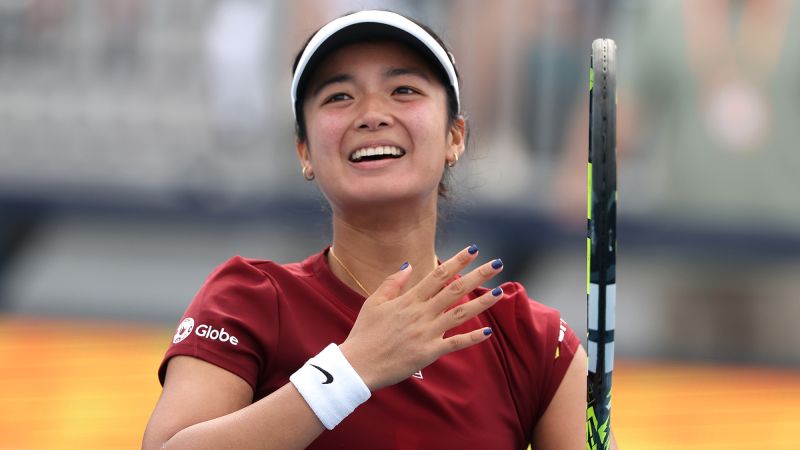
It wasn’t supposed to go this way. Madison Keys, fresh off her Grand Slam glory in Melbourne, was meant to cruise through Miami. She was seeded, seasoned, and styled for victory. Instead, she was stunned—by a girl from Manila with no seed, no script, and absolutely no interest in waiting her turn.
Alexandra Eala didn’t roar. She arrived—subtly, elegantly, and with a grip on the match that never once looked fragile. There were no theatrics. Just precision. Just presence. Just a win that felt like the future stepping in unannounced.
The Girl Who Doesn’t Blink
What Eala represents isn’t just talent—it’s timing. Her rise collides with a moment when the WTA is both fractured and fertile. With legends fading and new stars fumbling for consistency, Eala brings something rare: composure. She doesn’t overhit. She doesn’t oversell. She simply performs.
And Keys? She played well. But against Eala’s rhythm, her experience looked like weight, not wisdom. It was as if Eala had memorized the playbook—and decided to edit it mid-point.
The real win wasn’t in the scoreline. It was in the way Eala owned the court as if she’d been there forever, even though we all knew she hadn’t.
More Than a Match
This isn’t an upset. It’s a signal. Eala is no longer a promising junior—she’s a disruptor. A name you will hear again. A face you’ll see in semifinals, not just side courts. And for Southeast Asia, it’s a coronation moment. One that says: You are no longer just watching the game. You’re shaping it.
What Madison Keys lost was more than a match. It was a chapter. The spotlight has shifted—and it’s illuminating a girl who plays like she has nothing to prove, and everything to change.
So when Alexandra Eala walked off the court, head high, racket low—you didn’t just see a teenager with a victory.
You saw the balance of power begin to tilt.







“De Minaur’s Confession: The One Shot He Covets from Alcaraz”
In the world of tennis, where every stroke is a testament to...
 Chris Marks1 Mins read
Alcaraz’s Night Sessions: Spotlight or Strategy?
The Philippe Chatrier court gleams under the Parisian lights, its retractable roof...
Joseph Bennett1 Mins read
“Caroline Garcia’s Hell Unveiled: A Love Story of Triumph and Turmoil”
In the glimmering world of professional tennis, where every serve and volley...
 Krista Freeland1 Mins read

Djokovic’s 21-0 Enigma: Is Roland Garros His Personal Labyrinth?
The Philippe Chatrier court stands silent, yet Novak Djokovic’s presence reverberates through...
Krista Freeland1 Mins read





Leave a comment