

The Immune System’s Secret War: Can We Train It to Kill Cancer?
Your body may already know how to kill cancer. The mystery is why it sometimes forgets—and how science is teaching it to remember.
 Kirsten CollinsApril 16, 20251 Mins read84
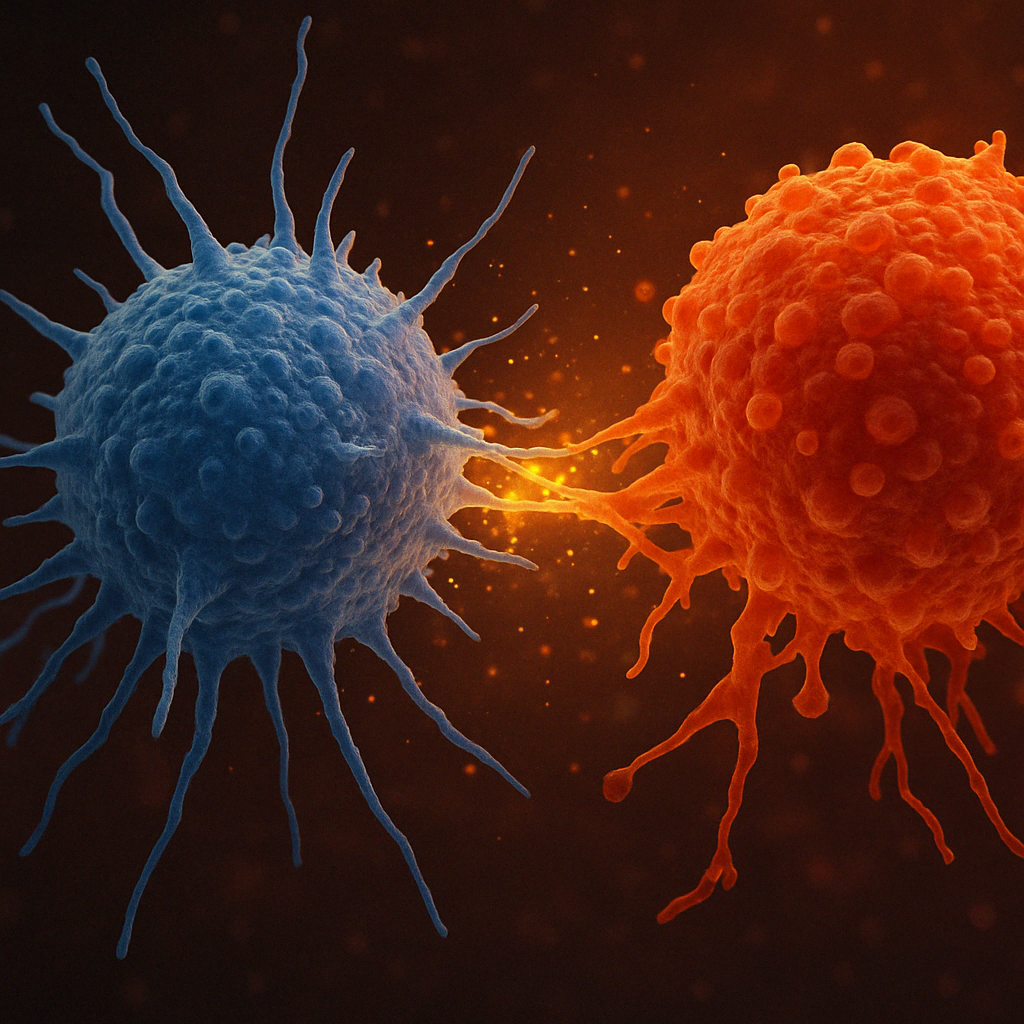
The moment cancer begins is not dramatic. It’s quiet, subversive, cellular—a single betrayal hidden in the script of life. And when it happens, your body doesn’t sound an alarm. No swelling. No fever. Just silence, as the invader hides in plain sight.
That’s the terrifying elegance of cancer. It doesn’t charge in like an infection; it whispers. It learns the language of the immune system—then rewrites it. Suddenly, your own defense system, trained to distinguish “self” from “foreign,” begins seeing cancer as… nothing. A blank space. A blind spot in the code.
A Game of Disguise, Played in Blood
How does cancer hide? It cloaks itself in proteins your body sees as normal—like PD-L1, a molecular “passport” that tricks immune cells into waving it through. Even worse, tumors send out chemical signals that exhaust T cells, draining their energy before they can strike. And in the twisted theatre of the tumor microenvironment, immune cells are often reprogrammed to protect the enemy instead of attacking it.
Scientists call this “immune evasion.” But what they’ve discovered in recent years is even more thrilling: the immune system can be trained to remember its purpose. To unmask the impostor. To attack.
Immunotherapy, once a fringe experiment, is now rewriting the rules of cancer treatment. Checkpoint inhibitors—like those targeting PD-1 or CTLA-4—remove the brakes cancer uses to stop T cells. CAR-T cell therapy arms immune soldiers with new genetic blueprints, customizing their kill list. And cancer vaccines, like whispers of a future where your body is immunized not against a virus—but against its own mutated shadow.
Not a Cure, But a Conversation with the Body
This isn’t magic. It’s still medicine. Immunotherapy doesn’t work for everyone. Some tumors outsmart even this upgraded system. Others mutate too fast. But for those it does help, the results can feel like science fiction made real—melanomas disappearing, lung cancers shrinking, long-shot patients outliving expectations.
“We’re not just targeting the cancer,” says Dr. Elizabeth Jaffee, an immunotherapy pioneer, “we’re retraining the immune system. It’s about giving memory to something that forgot how to remember.”
But perhaps the more unsettling question is this: if our bodies hold the key to defeating cancer, why did they ever lose it?







The Man Who Bled for Millions
He saved over 2.5 million babies, but no one ever recognized him...
Kirsten Collins2 Mins read

The Silence Before the Sneeze
A dead bird, limp on the edge of a sidewalk in Guangdong,...
Kirsten Collins2 Mins read

The Fetishization of Fear: RFK Jr. and the Vaccine Fetuses Lie
It begins, as these things always do, with a whisper dressed as...
Kirsten Collins2 Mins read
The Lie That Keeps Mutating
The seduction of scandal is ancient, but its latest host is disturbingly...
Kirsten Collins2 Mins read



Leave a comment